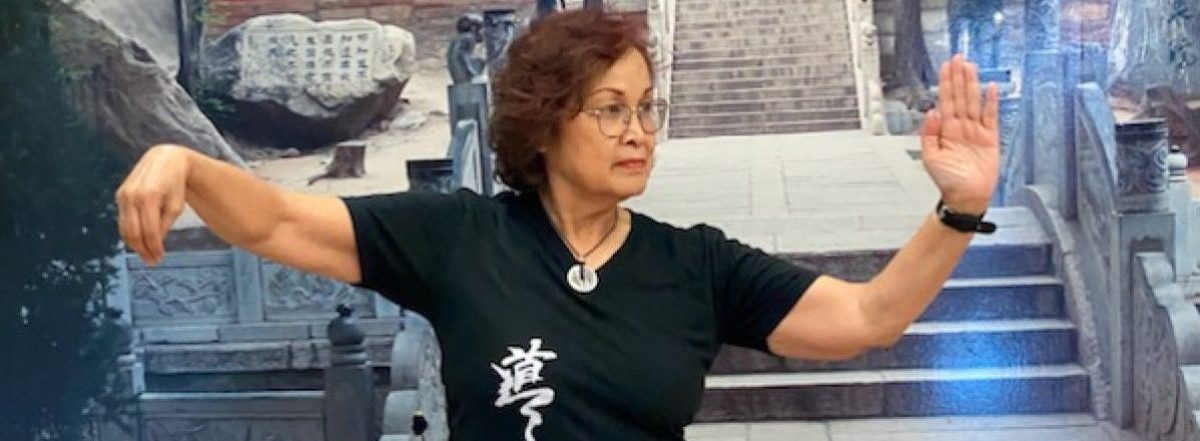
Centered and Grounded

One of the results of practicing yoga or any martial art form is becoming centered and grounded. Centering means more than being at the center of gravity or being physically balanced. As we seek mental and emotional balance, we are also seeking to be “centered,” and the result is personal peace and calm.

In yoga and other martial art forms the challenge is not only to seek self-peace and calm, but to also become grounded, which refers to being aware of the energy (qi) around and within us and keeping “rooted” and focused on the present moment.

As practitioners of yoga and the martial arts we engage in quiet sitting, moving, and standing meditations. We learn to focus on our breathing, which keeps us in the present moment, slowing and calming our mental and emotional energies, relaxing and clearing our mind.

It seems our daily lives are filled with so many distractions—television commercials costing millions of dollars for 30 seconds  enticing us to buy products, news media selling unique ideas of the news to raise their ratings, bright colors and lighted billboards fighting for our attention, and our personal cellular phones ringing or flashing updates nonstop telling us we’re losing out on a sale—so stop and purchase the item before it’ll be too late!  We float around all day pushed about by the energies fighting for our attention. We automatically respond to traffic lights, alarm clocks, cellphones, bills, health needs, family needs, and the disturbance goes on nonstop. By the time we go to bed at night we wonder why we are so exhausted, and why we did not accomplish everything on our list for the day.

However, when we feel grounded and centered, we take control of our life. We find ourselves on solid ground, not controlled by every energetic whim fighting for our attention. Rather, we tend to be focused on our daily agenda, shutting out disturbances, setting priorities, and completing our tasks one-by-one without anxiety. We take control of the steering wheel of our daily life purposefully and intentionally, including our nervous system, brain, and our overall health. We actually become consciously aware of any imbalance that may cause illness, stress, and anxiety.

When we practice our chair yoga and tai chi daily, we grow energetically centered and grounded. Anxiety and stress are also energy systems—but we want the correct chemical energies, such as serotonin, dopamine, endorphins, and oxytocin, which help promote happiness and pleasure while reducing depression and anxiety. Our brains release these positive chemical energies naturally as we do our tai chi and chair yoga exercises.

Keep keeping on…relax, stay calm, and focused!  You are doing GREAT!!

Journey Around the Sun–and the Five Elements

Earth with all its inhabitants takes a 365-day journey around the sun measuring a one-year cycle.  Observing the yearly journey, the ancient wisemen through the ages witnessed and recorded the changes in nature—plants, animals, weather, and humanity itself.  Over the hundreds or perhaps thousands of years observing earth’s journeys around the sun each generation investigated, defined, and documented all of nature’s changes, especially the seasonal changes that occurred each year, and how the changes governed human behavior, from personal health and survival to making life decisions.  The ancient observers concluded that there were five elements of nature that influenced and affected humans, not just for the ancients in their days, but also for us today.   

The sacred knowledge gathered was preserved, practiced and used through the years, most of the time in secrecy.  It was privileged information for only the holy men and women who served to “do miracles” to heal and guide the population.  We learn through history, cultural stories and folklore that the special group of privileged medicine men and women, often referred to as wisemen, were usually strong, healthy people known to possess special “wisdom.”  The “secret information” was handed down cautiously through generations.

As more people traveled the world, sharing of information especially on health and healing became unavoidable.  Soon “healing networks” of eastern healers and western doctors discussed medical and healing practices, and even today with the continual exchange of ideas and information worldwide, our understanding of health and medicine continues to shift and evolve.  

All medical practices—ancient, eastern, western—strive for the same outcome—the health and well-being of the person, even if their origins evolve from different philosophies.  Western medicine borrows largely from the ancient Greeks’ scientific approach using evidence-based diagnosis of the physical body and the direct symptoms of the illness, followed by “clinically proven” treatments.

On the other hand, eastern medicine practiced throughout Asia for thousands of years have evolved mostly from China and India where the practice is the treatment of the “whole person,” rather than just the symptoms.  For example, Chinese medicine considers the “balance of energy” which runs through the body via “invisible energy highways” called the “meridians.”  Even today throughout the world acupuncturists administer this 2,000-year-old practice by needling the meridians to release or add energy to specific body organs, in addition to using herbal medicines and remedial massage for healing to create balanced energy throughout the body.

Journey Around the Sun Qigong and Tai Chi programs, including chair yoga, borrow from both the eastern and western health and well-being practices.  I’m proud of it and wouldn’t have it any other way—because it works.  Personally, my American Indian doctor practices western medicine focusing on the kidneys, and my second American Indian doctor is my acupuncturist who sets needles along my meridians to release, add, and/or direct energy flow where needed.  My general practitioner (GP) doctor is American and all three of my doctors have information about my medical tests and well-being. All three encourage my tai chi, qigong and yoga practice supplemented with vitamins and any medication I need for my best overall health.  As their patient, I am grateful for all three of my doctors and the flow of information between them.

Now that some groundwork has been set in understanding the origins of eastern and western medicine and their relationship to the practices of tai chi and yoga, I am happy to introduce the FIVE ELEMENTS of nature that affects our health—mind, body, and spirit—over a journey of TIME—whether the seasons of a year or throughout our lifetime, often referred to as the “seasons of our life.”

The five elements are WOOD (spring), FIRE (early summer), EARTH (late summer), METAL (fall), and WATER (winter).  You will notice that while the five elements correlate to what we know as the four seasons, there is a fifth season—late summer.  In our western world we sometimes refer to it as “Indian summer.”  Google gives me two definitions for Indian summer:

  • a period of unusually dry, warm weather occurring in late autumn.
  • a period of happiness or success occurring late in life.

I am writing this treatise in the month of May, the early summer season, which is FIRE.  We will, therefore, get a close-up look at the five elements beginning with the Fire element.  Coming up next!

Stability…then Flexibility

Tai chi and Chair Yoga offer us the opportunity to learn about ourselves in the three dimensions of Jing, Chi (qi) and Shen, also known as the three treasures.   Jing puts us in touch with our physical body through the “form,” or the movement of our physical body.  Often our bodies are not ready for the difficult or more complex moves of yoga.  Nonetheless, through desire we commit to each step with intention to move forward, always moving forward—slowly and intently—to grow stronger until we hold our arms up a little longer and we pull ourselves up to our feet from a sitting position—15 times!  Wow!  What an achievement!!

Life is a purposeful process.  Once comfortable and confident that I can sit up straight, maintain a good posture, stack my bones, and hold my body stable, I can now concentrate better on deeper breathing, visualizing the energy entering my body—earth energy through the sole of my feet, to my knees, back of my thighs, up my back, over my head to my fingers.  The process of guiding the energy through my body does not happen overnight.  However, it doesn’t mean the energy is not moving through my body.  For example, whether or not I think about breathing, I am still breathing, and oxygen is still entering my body.  Most of the time I am unconscious of or unaware that I am breathing—I just breathe. 

Moving energy through my body means visualizing and moving with intention, pulling energy to areas of my body that need the most vital energy, especially through my meridians to feed specific organs, or to an injured or painful part of my body that needs healing.  Learning to do any new treatment or activity takes practice.  After all by nature, its divinity and creation, I am given the opportunity to live this life the best way I know how, and for as long as I am able to, and learning to energize and heal my body makes great sense.

I like to use the analogy of a lemon. Imagine you are holding a nice large yellow lemon in your hand. Feel it’s smoothness. Smell it. Now begin to peel the lemon then bite into it. Just writing this description triggers my taste glands and my mouth begins to water. I would also bet that most of you reading this have the same reaction. And that is my point–the strength of our thoughts and brains! We activate our salivary glands by our thoughts and imagination. It is not a talent privy to only certain people. We all have that “talent” and “ability”–to move energy through our body, and some of us are “gifted” to use this ability to “heal” ourselves and others. Think of it as a “brain or thought muscle.” For example, we all have leg muscles. Runners have stronger and more developed leg muscles because they work on it. Nonrunners’ leg muscles are not as developed.

Likewise, meditation–sitting, standing, moving–strengthens our thoughts (like strengthening our muscles) to help create calmness, clarity, focus which is translated to and activated in our body.

Energy pulled through my body includes “emotions” that I allow to run through my body.  I choose the emotional energy that I run through my body—good and bad.  It is my choice to replace negative emotions with positive emotions that benefit my physical well-being because it is my responsibility to not only take care of this body, but to also direct it to live and fulfill my purpose—the why to what I do.

We have addressed the jing, the physical form; the chi (qi) which is the energy; and now I move to the third treasure, the shen.  Shen is like the life force, and hence the humblest of the treasures. This means I reconcile the what and who I am (through learning stability) to the why—and the shen in all its humility directs me to service (to do, give, share)—the best me there is, whatever it means to me (flexibility in my actions).

Stability holds me in place (grows roots) as I develop the strength and wisdom to be balanced, to eventually have greater flexibility and direction—physically, mentally, and spiritually. 

Tai Chi and Yoga – Ancient Practices for our Modern Day

Tai Chi and Yoga are ancient mind-body practices that emanate from different countries.  Both seek harmony of mind, body and spirit to release stress and anxiety from our daily work, worries and even the wearing down of the body and mind through the aging process.

Both Tai Chi and Yoga are forms of mind, body, spirit exercise.  Tai Chi is also described as a martial arts practice because some of its movements can be used for self-defense and combat.  Those same martial arts movements are used in slow motion to stretch muscles, align bone structure and enhance breathing practices. Slow movements with knees bent develop strong muscles, flexibility, balance, together with deep breathing rhythm promotes and sustains good physical and mental health.

Yoga is not known as a martial art.  However, it also focuses on meditation and breathing while stretching and holding poses.  When comparing Yoga and Tai Chi, it is easy to say that Tai Chi is movement and Yoga is stretching and holding poses.  However, when looked at more closely, you’ll find that Tai Chi incorporates many holding positions to engage muscles, especially when working on the eight vessels, to generate and store energy throughout the body.  On the other hand, Yoga also includes slow movements from one pose to the next.  A good example is the “yoga flow” where you move from one pose to another in a deliberate way, inhaling and exhaling while holding poses for a few seconds and moving into the next pose. 

As a certified instructor of Chair Yoga, Qigong, and Tai Chi, I encourage my students to do both practices for their whole well-being—physical, mental, spiritual, emotional.  These ancient practices do not require you to be in top physical condition.  Rather, it will help any person, any age, to find an equilibrium in life—a balance of good health to enjoy life as long as you want.  My only caution is to listen to your body and do only what you are able to do at the moment.  Gradually increase your movement, range of stretches and holding poses. If you exercise daily, you’ll recognize the growth spurts of your strength and flexibility. Do enough exercises daily and you’ll see your body grow stronger, your attitude and patience improve, you’ll stand taller, and you’ll know what your body needs just by how you feel. 

When you are practicing Tai Chi and Yoga, focus first on your breathing and move in slow, deliberate, intentional motions moving from one pose or stance to another.  Picture in your mind the movement of energy flowing through your body.  Visualization will be discussed more as we practice.

Tai Chi and Yoga are very popular today because we are seeking health, relaxation and balance in our lives. 

Congratulations on stepping up for yourself!  Join the party!

deb gomez

Deb Gomez, a Medical Qigong Certified Instructor, teaches the fundamentals of qigong and tai chi. She also teaches chair yoga to the senior population in the Phoenix area. Her goal is to share the knowledge and practice with anyone seeking to live a healthier lifestyle physically, mentally and spiritually. Deb’s students learn deep, proper breathing techniques, body alignment to improve their posture and basic tai chi steps to achieve better balance and flexibility. The ancient practices of qigong, tai chi and yoga promote a clearer mind, relaxation and a wholesome, healthy lifestyle.

Deb dedicates herself to continual training and research into her craft, especially in teaching the fundamentals of qigong and tai chi with regards to the five elements of Traditional Chinese Medicine (TCM). Her instructions are easy to follow, and her classes are fun!